




Latest Blogs

A short overview of the insights you'll find here - covering industry trends, agency updates, success stories, and expert perspectives.
The Empathy Algorithm: Accelerating Medical Education through AI-Driven Spatial Computing
My background in Electronics Engineering and Business Strategy has taught me one core principle: the most impactful technology is the one that solves a critical human problem with elegant, scalable engineering. In healthcare, this means moving beyond better scanners and faster labs to address the biggest bottleneck in medical education: the gap between clinical knowledge and compassionate, effective human interaction.
This is where the convergence of Artificial Intelligence (AI) and Spatial Computing (XR) is poised to rewrite the rules. We are not just creating better simulations; we are building the Empathy Algorithm.
The Challenge of the Human Element
The traditional model for teaching doctors both soft skills (like delivering bad news or handling an anxious family) and technical skills (complex surgical maneuvers) is fundamentally constrained.
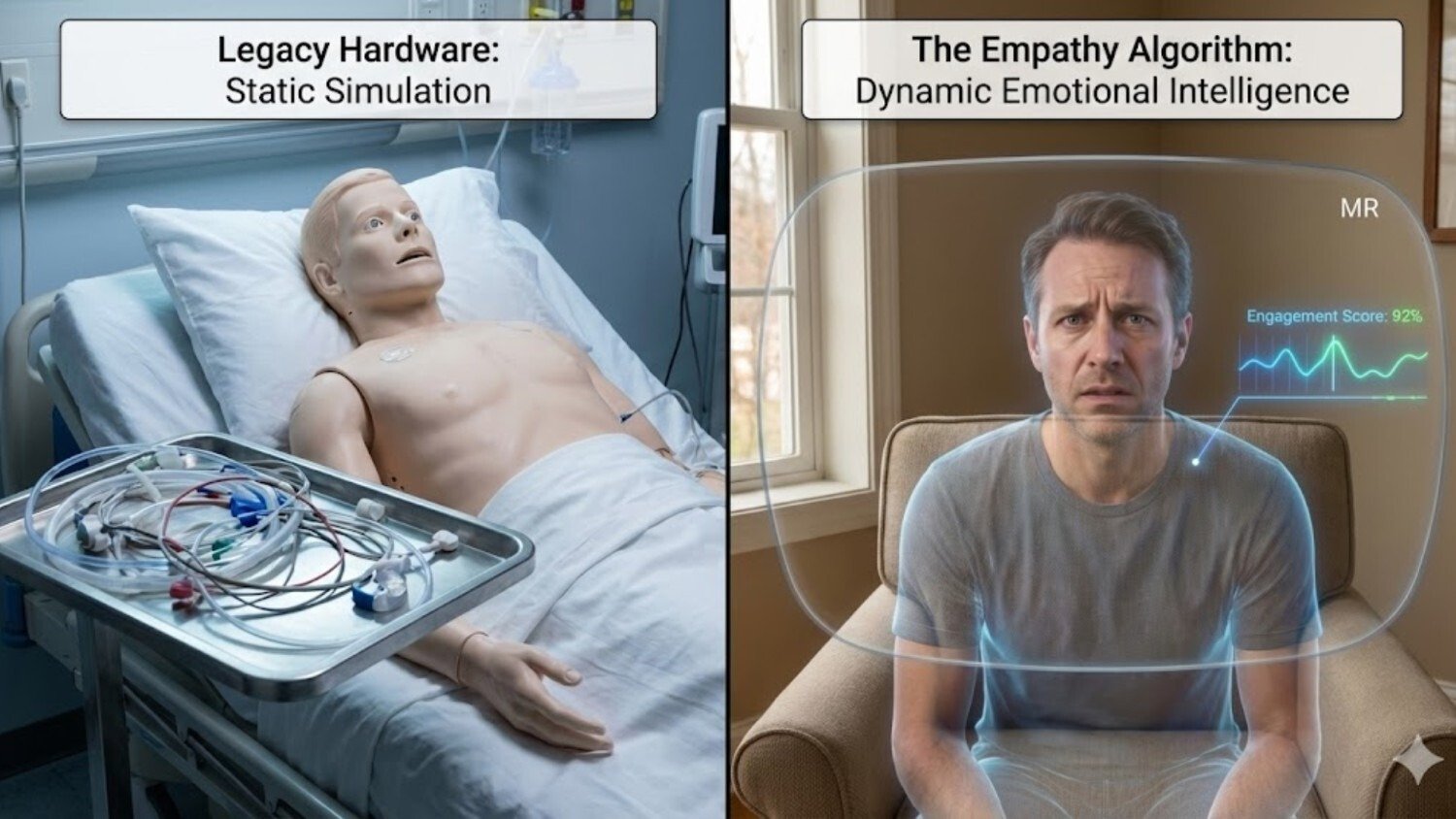
- Cadavers and Manikins: Essential for anatomy and procedural skills, but they offer zero emotional feedback. They are static systems, lacking the essential human variables.
- Standardized Patients (Actors): Excellent for practicing communication. However, they are expensive, their availability is limited, their performance can vary, and, critically, they cannot safely replicate high-stakes or rare scenarios like a patient going into anaphylactic shock during a consultation.
The learning is neither repeatable nor scalable. In engineering terms, traditional methods introduce too much variability and have a low throughput for high-fidelity training. We need a system that can deliver perfect, standardized practice globally, anytime.
The Solution: Virtual Standardized Patients
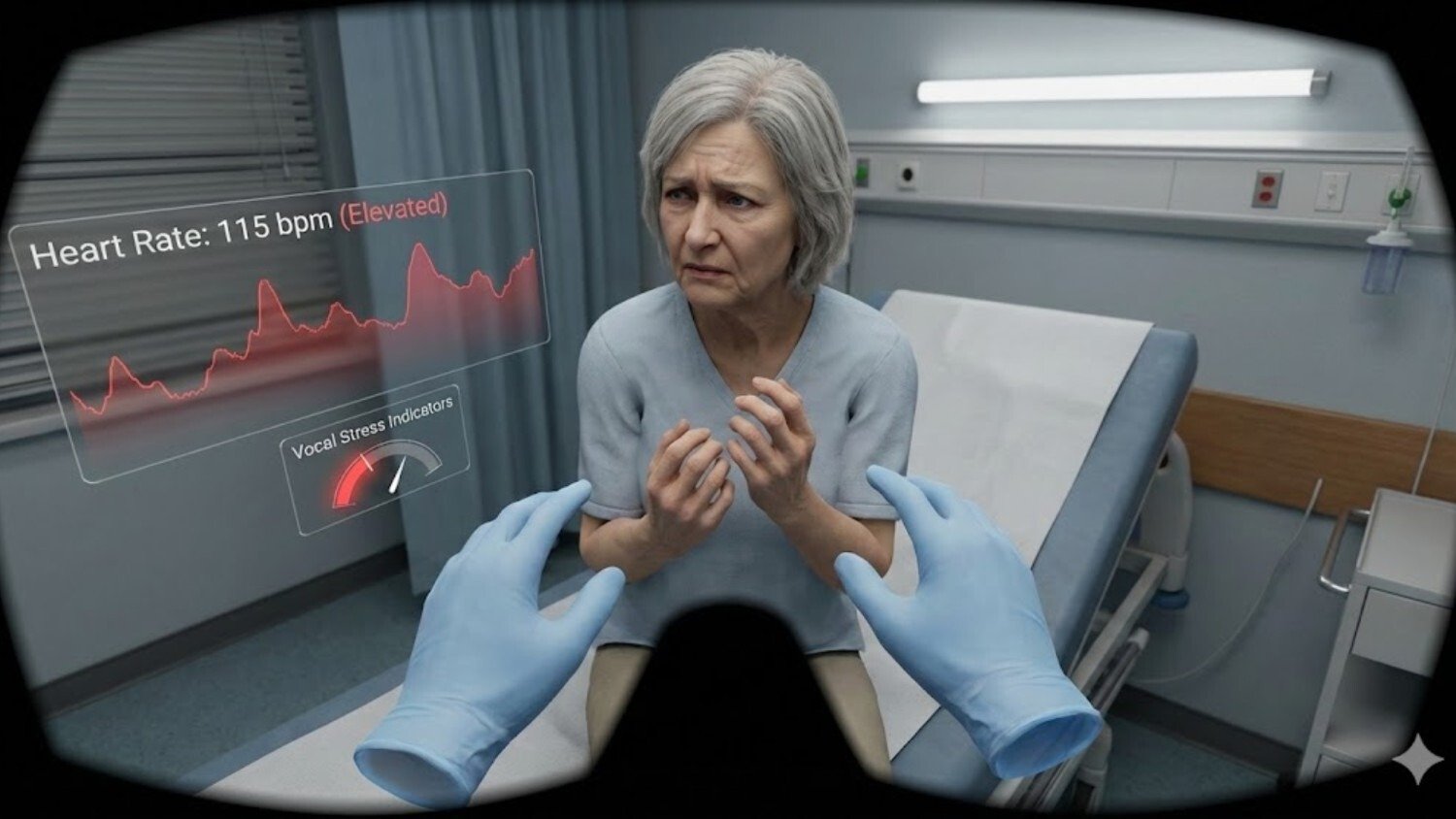
The answer lies in fusing generative AI with highly realistic virtual environments. This blend creates an AI-Driven Virtual Standardized Patient (VSP)—an intricate non-player character (NPC) residing in a spatial computing environment (Virtual Reality or Mixed Reality).
This VSP is more than a digital avatar; it is a highly sophisticated, data-driven model.
- Powered by LLMs: Large Language Models (LLMs) provide the deep conversational fluency. The student can speak naturally, and the virtual patient doesn’t respond with a canned script, but with a dynamic, context-aware reply based on a comprehensive medical and personality profile.
- Emotional Intelligence Layer: The system tracks the student’s speech patterns, tone, eye contact, and clinical decisions. If the diagnosis is delivered abruptly or the doctor’s tone is poor, the patient's anxiety level (a measurable parameter in the simulation) spikes, and their physical manifestation—a change in breathing, tears, or a frustrated posture—reflects it.
This is the heart of the Empathy Algorithm. It treats human interaction not as a simple flow chart, but as a complex feedback loop. The system provides immediate, objective feedback: “Your use of medical jargon increased the patient’s confusion score by 30 points.” This allows the student to debug human interaction in real-time.
Psychological Fidelity: The Real Engine of Learning
Why is this so much better than a traditional video role-play? It comes down to Psychological Fidelity.
For technical practice (like a complex surgery), the system must have low latency—meaning the virtual scalpel must react instantly to the student’s hand movement. But for empathy training, the system must create genuine emotional pressure.
When a student practices breaking bad news and the virtual daughter of the patient begins to cry and question the physician’s competence, the student experiences a moment of real cognitive and emotional load. This pressure is what bridges the gap. It transforms theoretical knowledge ("Always use gentle language") into muscle memory ("I must slow down and validate their feelings to manage this escalating situation").
It is the wireframe beneath the anatomy that makes the difference.
Engineering Scalability and Business ROI
From a systems and business perspective, the case for AI-driven spatial computing is compelling. The return on investment (ROI) is achieved through standardization and scale:
| Metric | Traditional Training | AI/Spatial Computing Training |
|---|---|---|
| Cost | High (actors, facilities, maintenance) | Low operational cost (software licensing) |
| Consistency | Variable (depends on actor/instructor) | Perfect (same AI personality/scenario every time) |
| Accessibility | Location-dependent (must travel) | Global (train anywhere with a headset) |
| Scenarios | Limited (safety and actor fatigue) | Unlimited (rare diseases, mass casualty events) |
This democratization of high-quality training is a fundamental leap. It means a student in a rural center can get the exact same high-stakes exposure as a student at a top-tier urban hospital.
Companies Leading the Charge
The infrastructure for this shift is already being built by several forward-thinking companies:
- GigXR is pioneering the use of Mixed Reality (MR). Their "HoloScenarios" and "Holographic Patients" use devices like Microsoft HoloLens to project hyper-realistic, 3D animated patients into a physical classroom. This allows groups of students to collaborate on a holographic patient in their own space, retaining situational awareness of the real-world environment.
- Virti focuses heavily on the soft-skills and analytics side, using AI Virtual Humans to facilitate difficult conversations like obtaining consent or breaking bad news. They back this up with data-driven feedback that measures 'empathy performance'—quantifying an otherwise subjective skill.
- PCS Spark is mastering the AI patient interview. Their bespoke platform leverages Large Language Models to allow medical students to communicate naturally and fluidly with their digital patient for history-taking and clinical reasoning. The goal is to hone diagnostic accuracy by ensuring students ask the right open-ended questions.
SimX has demonstrated its effectiveness in high-stakes environments, notably through the SimX VALOR program with the US military. They provide fully immersive VR medical simulations that can replace bulky physical manikins with highly customizable, portable, and multi-user environments for trauma and team training.

Upgrading the Human Capacity
Spatial computing is not designed to replace the physician; it is designed to upgrade the physician.
We are applying rigorous engineering and analytical strategies to the most human and subjective element of medicine: empathy and bedside manner. By giving future doctors unlimited, safe, and standardized practice with patients who react realistically, we prepare them to manage not just the illness, but the individual experiencing it.
The Empathy Algorithm is more than a technological breakthrough; it is a commitment to a future where every medical professional, regardless of their location, is trained to be both clinically brilliant and profoundly human.